In January 2026, researchers at Ludwig Maximilian University of Munich published a direct measurement of BPA migration from seven commercially available pacifiers. All seven leached detectable BPA — including products carrying "BPA-free" labels on the packaging.
The worst result came from a pacifier that was explicitly labeled "BPA-free." It released 26,536 nanograms of BPA. The European Food Safety Authority's 2023 revised tolerable daily intake is 0.2 nanograms per kilogram of body weight per day. For a 6-kilogram infant, that worst-performing product exceeded the threshold by a factor of roughly 11,600.
No major pacifier buying guide published before this study cited it. We reviewed every pick in this guide against its findings before publishing.
7 of 7
pacifiers tested
leached detectable BPA in the January 2026 LMU Munich study
26,536 ng
highest single result
from a pacifier explicitly labeled BPA-free
11,600×
above EFSA daily limit
for the worst-performing product, based on a 6 kg infant
What the study found, product by product
The seven tested pacifiers and their measured BPA migration:
| Pacifier | Shield (ng) | Teat (ng) | Total (ng) |
|---|---|---|---|
| FUNNYBABY | 26,536 | Below detection | ~26,536 |
| Novatex | 118 | 467 | 585 |
| HEVEA | 276 | 219 | 495 |
| MMBABY | 104 | 350 | 454 |
| Unknown Chinese brand | 33 | 179 | 212 |
| NUK (transparent) | 35 | 59 | 93 |
| NUK (opaque) | Below detection | 33 | ~33 |
Every result, including the best one (NUK opaque, ~33 ng), exceeds the EFSA's 2023 threshold for typical infant use. This isn't a problem with a few bad actors — it's a category-level finding.
One of our picks, HEVEA, appears in this table at 495 ng total. We include it anyway, for a specific reason: it is the only pick whose result comes from a product with confirmed one-piece natural rubber construction and published third-party test results. We address this directly in the HEVEA section below.
Why "BPA-free" doesn't mean BPA-free
Two mechanisms explain how a "BPA-free" label can be accurate on one level and meaningless on another.
First, polypropylene — the plastic used in most pacifier shields — contains residual BPA introduced during its synthesis, not intentionally added afterward. The FUNNYBABY result makes this concrete: 26,536 ng came almost entirely from the shield, with the teat contributing nothing detectable. The label was accurate about intentional addition. It said nothing about what the manufacturing process left behind.
Second, when brands reformulate away from BPA, the replacement is often BPS or BPF — structurally similar bisphenol compounds. A March 2026 study in Environmental Research found both show endocrine-disrupting activity comparable to BPA. Switching from BPA to a bisphenol analogue is not a safety improvement.
The material hierarchy
Risk order, lowest to highest:
- One-piece 100% natural rubber — no plastic shield, no polypropylene, no BPA synthesis pathway in the shield
- One-piece food-grade or medical-grade silicone — latex-free alternative, fully sterilizable, no PP shield
- Natural rubber nipple + confirmed rubber shield — acceptable if shield material is confirmed natural rubber
- ❌ Natural rubber nipple + polypropylene shield — shield is the primary BPA source per the study
- ❌ Any plastic (PP, PVC, ABS) as primary contact material
One note on natural rubber: even one-piece natural rubber products like HEVEA showed BPA in the Munich study (495 ng), likely from vulcanization processing agents. Choosing one-piece natural rubber or silicone reduces — but does not eliminate — trace BPA. It does eliminate the highest-risk pathway (PP shield), and the reduction is substantial: 495 ng versus 26,536 ng is a 50-fold difference.
One-piece construction also eliminates the nipple-to-shield seam where bacteria accumulate — a reason the AAP recommends it independently of the chemical exposure question.
Our 5 picks
1. HEVEA Classic Natural Rubber Round Pacifier — Best overall

The HEVEA Classic Natural Rubber Round Pacifier is pressed from a single mold of natural Hevea rubber — no polypropylene shield, no separate parts, no chemical dyes. HEVEA uses only FDA-approved plant pigments for color and publishes SGS lab test results. It meets the EU EN 1400 standard and holds B Corp certification at the brand level.
This product appeared in the January 2026 LMU Munich study at 495 ng total BPA — shield and teat contributed roughly equally, consistent with natural rubber processing chemistry rather than a PP-shield problem. Among the seven tested products it was the third-lowest result. Given that HEVEA is also the most transparent brand we evaluated, with published third-party test documentation and confirmed pigment sourcing, it remains the strongest starting point for families minimizing exposure.
Available in round and orthodontic shapes. Latex allergy note: skip to pick 3 or 4 if your infant has a confirmed latex sensitivity.
2. Natursutten Natural Rubber Butterfly Pacifier — Best butterfly shape
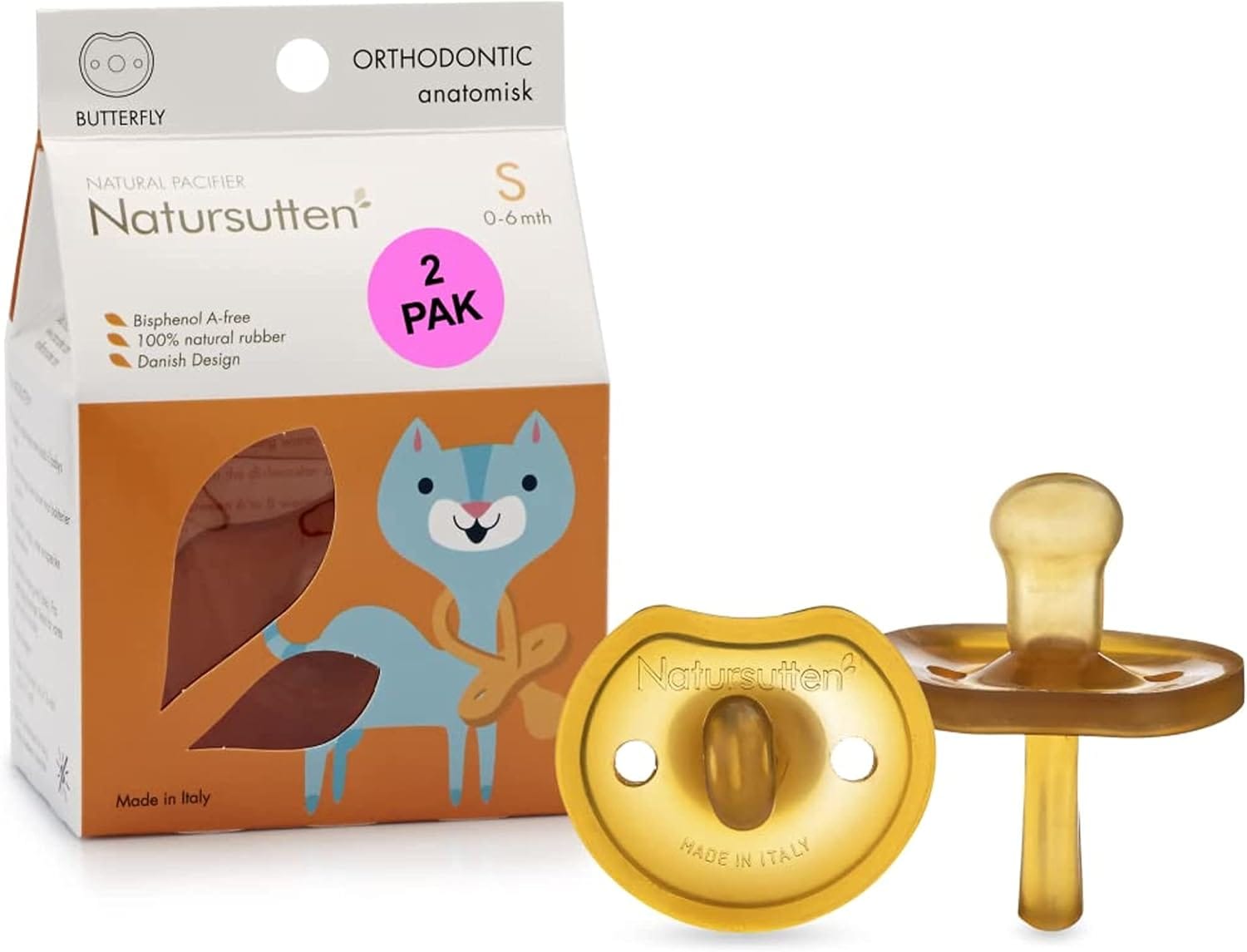
The Natursutten Natural Rubber Butterfly Pacifier is a one-piece mold from natural Hevea rubber with a butterfly-shaped shield — the shield is rubber, not polypropylene. Natursutten discloses the formulation directly: pure Hevea latex, no synthetic rubber, no BPA, no phthalates. The butterfly shape gives more facial clearance than a round shield and reduces the contact area around the infant's mouth, which some infants prefer and which pediatric dermatologists recommend for drool rash prevention.
One caveat compared to HEVEA: Natursutten does not publicly publish third-party lab test documentation. The brand's material disclosures are explicit, but independent verification comparable to HEVEA's SGS results is not available on their site. Made in Italy. Same latex allergy note applies.
3. Ryan & Rose Cutie PAT Pacifier + Teether — Best silicone

The Ryan & Rose Cutie PAT is 100% medical-grade silicone in a one-piece patented construction — no polypropylene shield, no latex, no separate parts that can detach. Certified to CPSIA and ASTM F963. Free of BPA, PFAS, and phthalates per brand disclosure. The dual function as both pacifier and teether makes it practical through the teething stage without switching products. Silicone is fully dishwasher- and steam-sterilizer-safe.
Best choice for latex-sensitive families, or for use past six months when teething begins. One disclosure gap: the brand does not confirm whether colorants are AZO-free. If that matters for your situation, contact Ryan & Rose before purchasing.
4. Dr. Brown's HappyPaci One-Piece Silicone Pacifier — Hospital pick
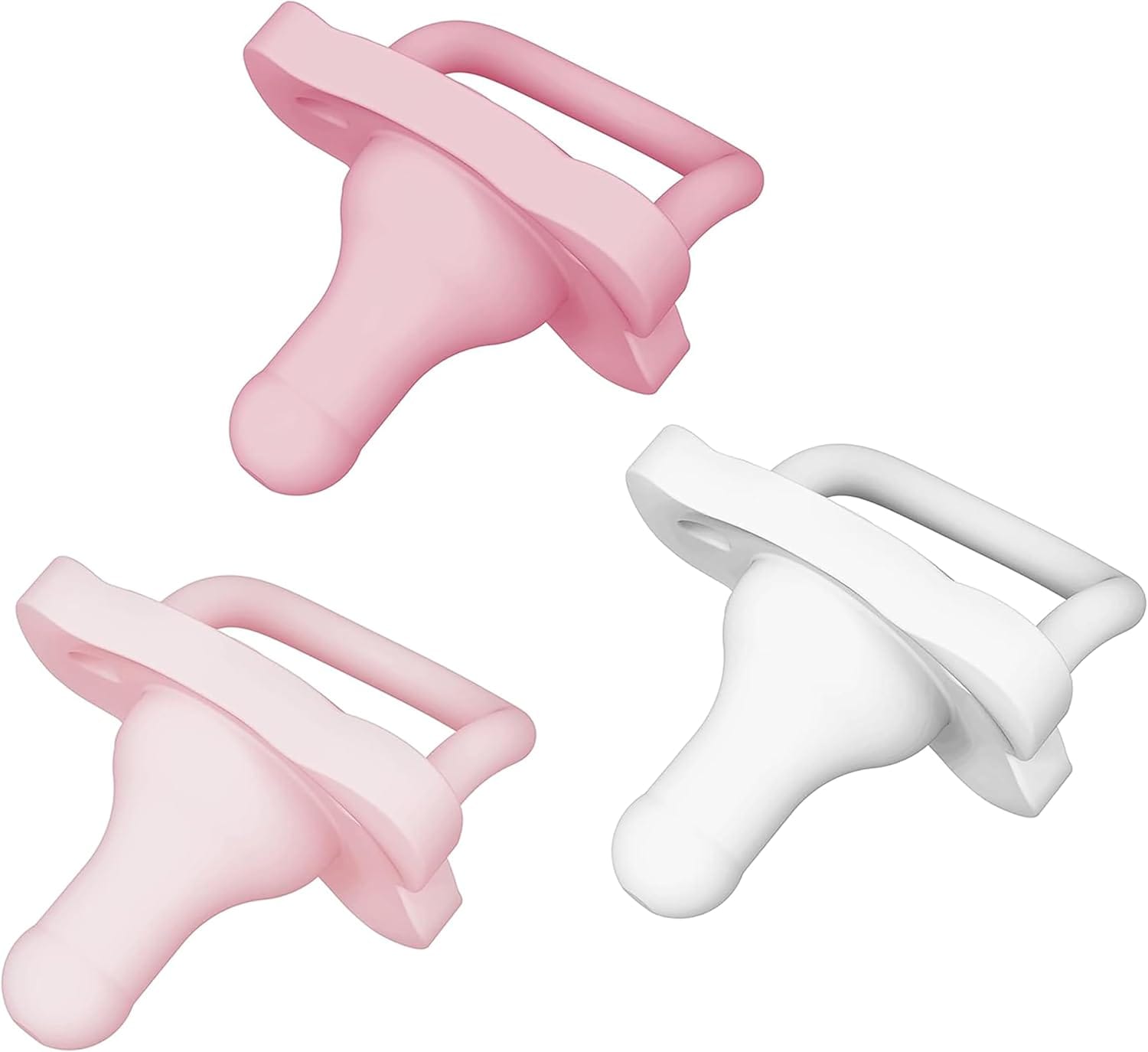
The Dr. Brown's HappyPaci is a one-piece 100% silicone pacifier used in hospitals and NICUs. The butterfly-shaped shield is silicone throughout — no polypropylene structural frame. It is shaped to match Dr. Brown's bottle nipples, which helps bottle-fed infants accept the pacifier. The open-back design and butterfly shield reduce skin contact and allow air circulation to minimize drool rash.
Hospital and NICU adoption is a meaningful proxy for materials safety, even without published independent test results. For families already using Dr. Brown's feeding bottles, the nipple-shape match is a practical advantage.
5. Ecopiggy EcoPacifier Natural Rubber — No colorants

The Ecopiggy EcoPacifier is a one-piece natural rubber pacifier with zero added colorants — the only pick in this guide with no dyes at all. Fewer certifications than HEVEA, but the no-colorant formulation removes one additional variable. Budget-priced for families who want one-piece natural rubber construction without the premium certification overhead. The tradeoff is less documented material verification compared to the top picks. Same latex allergy note applies.
What we passed on
MAM uses a confirmed polypropylene shield. Shield material is a disqualifier regardless of nipple material.
Mushie FRIGG Silicone — Mushie's own product page describes the shield as "100% food grade PP plastic." A silicone nipple on a polypropylene shield is not safer than all-plastic construction; the BPA pathway exists in the shield.
Philips Avent Ultra Air — Avent carries DEKRA safety certification, but Czech consumer testing organization dTest found detectable BPA above threshold in independent testing of the Avent Ultra Air model. Where brand-commissioned certification and independent consumer lab testing conflict, the independent test is the stronger signal.
Itzy Ritzy Itzy Soother — natural rubber nipple with a BPA-free plastic shield. The plastic shield fails our construction criteria regardless of its BPA-free label; the January 2026 study demonstrated that BPA-free plastic shields can still leach BPA.
NUK — two NUK models appeared in the LMU Munich study. The best-performing NUK result (~33 ng, opaque shield) was the lowest in the tested cohort, but still exceeded the EFSA threshold for typical infant use.
FUNNYBABY and Novatex — both appeared in the study with significant BPA migration (26,536 ng and 585 ng respectively). FUNNYBABY carried a "BPA-free" label.
BIBS (natural rubber line) — BIBS is a credible brand with EN 1400+A2 certification, but their published documentation does not specify whether the shield is natural rubber or polypropylene. Without confirmed shield material, we cannot include it. If BIBS publishes that data, we will revisit.
Cover image: Alexander Grey via Unsplash (Unsplash License) — source.