

ENDO 2026, the annual meeting of the Endocrine Society held in June 2026, reported that endocrine-disrupting chemicals — BPA, phthalates, and parabens — were detectable in 100% of breast milk and infant urine samples collected from babies as young as six months. The exposure is universal, not exceptional.
A separate 2016 study published in Environmental Science & Technology by Stapleton, Patisaul, and colleagues at Duke University — with analysis support from the Environmental Working Group — answered a harder question: where does it come from in nursery gear specifically? The researchers found TDCIPP (tris(1,3-dichloro-2-propyl) phosphate), a chlorinated organophosphate flame retardant and a California Prop 65 listed carcinogen, in 100% of infant urine samples. TPHP (triphenyl phosphate), an endocrine disruptor that interferes with thyroid hormone signaling, appeared in 93% of infants tested. Infant TDCIPP levels were approximately five times higher than their mothers'. The source: polyurethane foam in baby products in the home.
These are two different studies measuring two different things. We cite both because they answer different questions. The ENDO 2026 data tells you how widespread chemical exposure already is. The Stapleton 2016 data tells you which nursery materials drive one specific, measurable exposure pathway.
What we look for
The foam-to-urine pathway
Polyurethane foam does not contain flame retardant chemicals in a stable, locked form. Over time, those chemicals migrate out of the foam into household dust. Infants spend the majority of their waking hours within a few inches of floor level — on play mats, in bouncers, on changing pads. Hand-to-mouth behavior is constant at this developmental stage. The Stapleton study measured the result directly: infant TDCIPP and TPHP urine concentrations correlated with the number of PU foam baby products present in the home. More foam products, higher infant levels.
The pathway is: foam → dust → hand-to-mouth → measurable infant urine concentration. Removing PU foam from the nursery interrupts it.
TDCIPP and TPHP: what they are
TDCIPP was widely added to polyurethane foam after California's original TB 117 flammability standard created pressure to pass open-flame tests. It was added to an enormous category of upholstered furniture and infant products beginning in the 1980s. California's Office of Environmental Health Hazard Assessment listed TDCIPP as a known carcinogen under Prop 65 in 2011.
TPHP replaced some brominated flame retardants (PBDEs) after those were phased out for toxicity. It is an endocrine disruptor documented to interfere with thyroid and reproductive hormones. It migrates out of foam even faster than TDCIPP because it is not chemically bonded — it's a reactive additive.
Neither chemical is disclosed on product labels. You cannot see them listed. The only protection is avoiding PU foam as a primary fill material.
TB 117-2013 does not require flame retardants
California revised its flammability standard in 2014 from TB 117 to TB 117-2013. The critical change: the new standard tests smolder resistance from a cigarette rather than open-flame resistance from a butane lighter. Products made with inherently smolder-resistant materials — wool, natural latex, tightly woven organic cotton — can pass TB 117-2013 without any chemical treatment.
Look for the TB 117-2013 compliance label and the language "No flame retardant chemicals were used to meet this standard." That sentence is required language when no chemicals are used. Its absence on the label does not mean chemicals are present — but its presence is a positive confirmation.
Changing pads and nursing pillows are exempt from flammability standards entirely. No TB 117 compliance is required for these product categories. Brands that advertise "FR-free" on changing pads are confirming something they were never required to do — which is exactly the kind of proactive disclosure worth rewarding.
How we weight certifications for nursery gear
Natural fills that need no chemical treatment
Wool is self-extinguishing: it chars at the flame source and does not sustain combustion. This physical property meets California TB 117-2013 without any chemical additive. Natural Dunlop latex behaves similarly — high density and natural rubber chemistry provide inherent smolder resistance. Buckwheat hull fill is inert organic material; flammability standards don't apply to it in the categories where it's used.
These are not marketing claims. The physical chemistry is the protection.
Our picks
1. Naturepedic Organic Changing Pad — Best overall
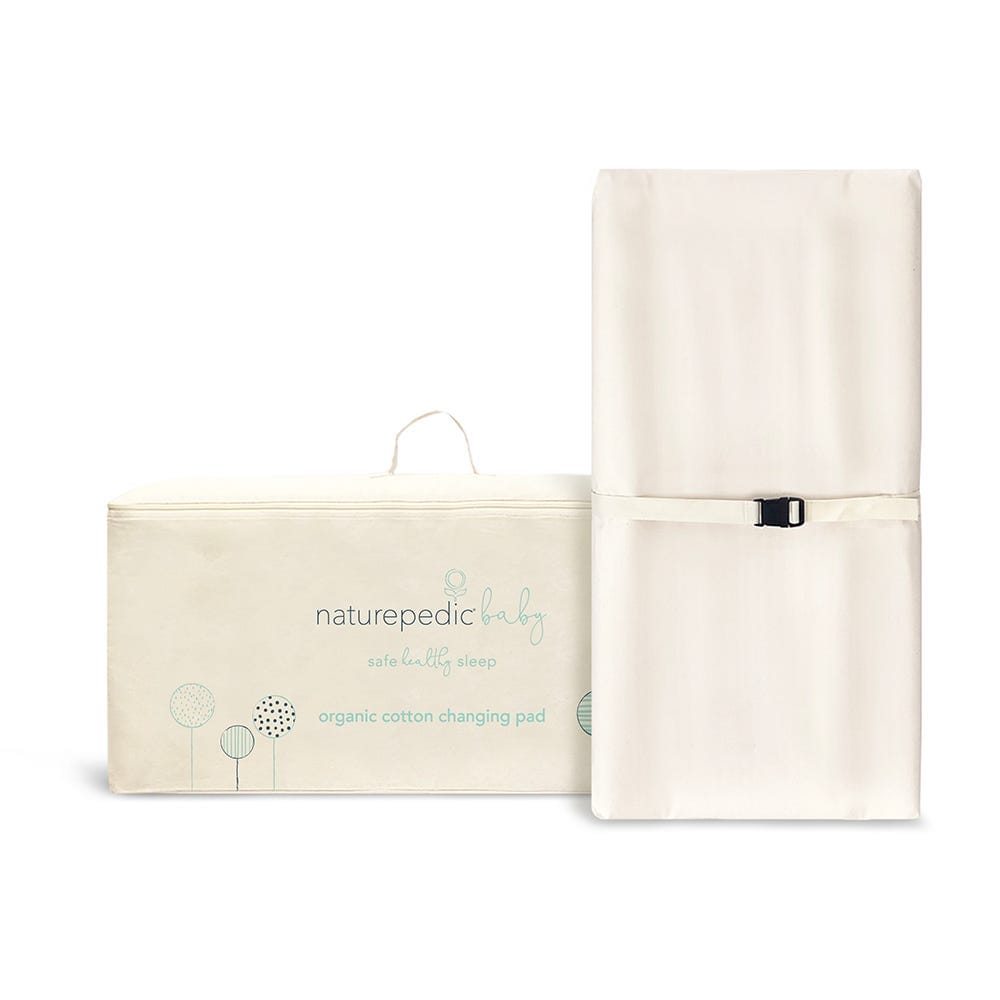
The Naturepedic Organic Changing Pad uses PE (polyethylene) foam — not polyurethane — as its core. The distinction matters directly: PE foam does not require the flame retardant chemistry that PU foam does to pass smolder tests. The waterproofing layer is sugarcane-derived PE, replacing the vinyl and PVC that most changing pad covers use. GOTS-certified organic cotton outer. Formaldehyde-free, explicitly FR-free, and the only pad on this list to carry MADE SAFE certification alongside Greenguard Gold.
Available in standard, large, and mini sizes ($129–$149). The MADE SAFE mark requires disclosure and safety assessment of every ingredient — it's the broadest verification available for a product like this.
2. DaVinci Contour Changing Pad — Best budget

The DaVinci Contour Changing Pad uses polyester fill rather than PU foam, which removes the TDCIPP migration pathway at approximately $49. The cover is PVC-free PE. Greenguard Gold certified for low VOC emissions and formaldehyde. FR-free claim confirmed.
Polyester fill is a synthetic material — the trade-off from the Naturepedic is that the fill is not natural fiber. But for families where price is the primary constraint, the key variable is whether the fill triggers the flame retardant chemistry, and polyester at this fill density does not.
3. Toki Mats Organic Cotton Play Mat — Best play mat overall
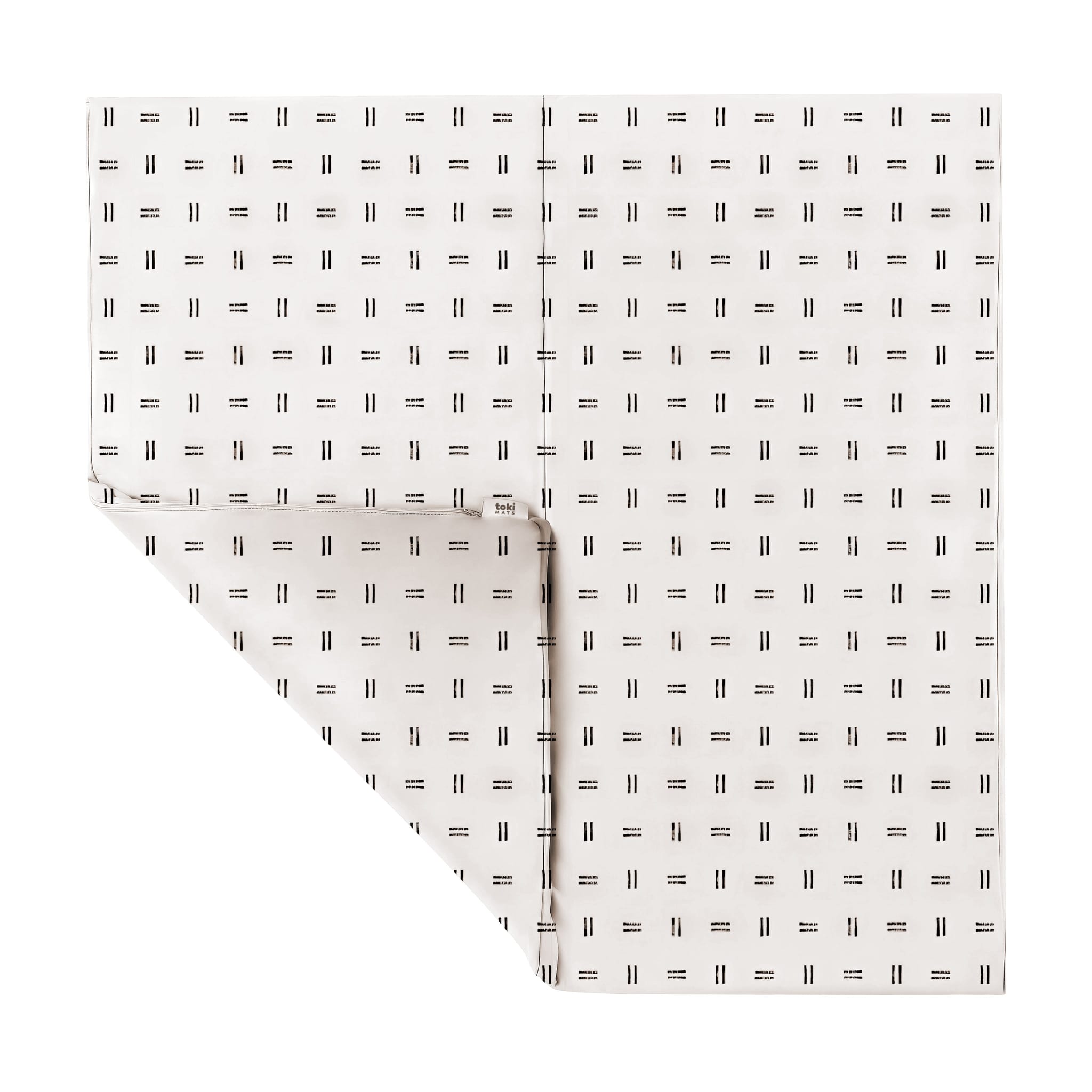
The Toki Mats Organic Cotton Play Mat uses 1-inch natural Dunlop latex fill — the material choice that makes the certification conversation shorter. Natural latex is inherently flame-resistant without chemical treatment; no TDCIPP or TPHP can migrate from latex because those chemicals were never added. The outer is GOTS-certified organic cotton. OEKO-TEX certified and independently tested for phthalates, PFAS, BPA, and heavy metals.
Available in three sizes: Standard (56×56 in.) at $185, Mega (70×70 in.) at $295, and Epic (79×79 in.) at $455. The standard size covers adequate floor space for tummy time and early rolling.
4. Piccalio Play Mat — Most cushion depth

The Piccalio Play Mat uses 1.5 inches of natural latex — half an inch deeper than the Toki mat — in a reversible GOTS organic cotton cover. TÜV Rheinland and OEKO-TEX certified. The waterproof liner uses TPU rather than PVC. At $189 for the standard size, it's the highest-cushion-per-dollar option in this category.
The reversible design means two coordinating fabric surfaces; neither contacts a waterproofing layer directly, so the organic cotton is the only thing touching the infant.
5. Bloom Baby Coco Stylewood Lounger — Best bouncer

The Bloom Baby Coco Stylewood Lounger addresses the two most documented toxic exposures in infant bouncers: the frame and the cover. The single-piece birch bentwood frame is formaldehyde-free, avoiding the off-gassing common in engineered wood composites. The front-facing seat pad — the only surface in contact with the infant — is GOTS-certified organic cotton knit. Bloom discloses explicitly on the product page: no polyurethane foam, no flame retardant treatment, and compliance with CA TB 117 without chemical addition. Cotton seat pad construction means no PU foam migration pathway. Made in Europe. Price: $289.
6. Blessed Nest Nesting Pillow — Best nursing pillow

No polyurethane foam. No synthetic fill. No chemical flame retardants.
The Blessed Nest Nesting Pillow uses organic buckwheat hull fill. Buckwheat is inert organic material — no flammability standard applies to it in this product category, so there is no chemical treatment pathway to begin with. GOTS-certified organic cotton cover. Adjustable firmness by removing or adding hulls through the zipper opening. Explicit FR-free claim.
The trade-off versus latex-core pillows: buckwheat is heavier per unit volume and the surface texture is slightly firmer. Neither is a safety trade-off, only an ergonomic one. Price: $118.
7. Butterr Nursing Pillow — Best latex nursing pillow

The Butterr Nursing Pillow uses a natural latex core with GOTS-certified organic cotton cover. Holds both GOTS and OEKO-TEX Standard 100 certification — the most complete certification stack of any nursing pillow we reviewed. Contoured design maintains shape through extended use without synthetic fill or chemical treatment. Price: $116.
For families who prefer the conforming feel of latex over buckwheat, this is the only nursing pillow we found that pairs natural latex fill with a full GOTS + OEKO-TEX certification stack.
What we passed on
Boppy Original Nursing Pillow — Polyester fill with no material certifications. (Separate note for context: the Boppy Original Lounger — a different product from the nursing pillow — was recalled in 2022, approximately 3.3 million units, after 8 infant deaths. The nursing pillow is a different product and is not subject to that recall, but clarity on which Boppy product you're referencing matters before purchase.)
My Brest Friend Organic Nursing Pillow — Despite the name, the core fill is PU foam. The outer fabric uses organic cotton; the interior does not. This is the exact fill material the Stapleton 2016 study linked to elevated TDCIPP in infant urine.
BabyBjörn Bouncer Bliss — 100% polyester fill and cover with no material certifications beyond basic safety testing.
Snuggle Me Organic Classic — Polyester fiber fill. The outer shell uses organic cotton, but the fill does not meet a different standard. "Organic" in the brand name refers to the cover material.
Standard EVA foam play mats without formamide-free certification — EVA (ethylene-vinyl acetate) foam uses formamide as a blowing agent in the manufacturing process. Without a specific formamide-free certification or test result, residual formamide off-gassing is a documented concern. Some brands have begun certifying formamide-free; look for that language specifically, not just "non-toxic."
Cover image: via Unsplash (Unsplash License) — source.